
Meet Hostly: Deploy Your Docker Containers Without the Infrastructure Homework
Hostly makes it easy to deploy and run containerized applications without having to manage the infrastructure underneath. Pay-as-you-go pricing, simple deployments, and no Kubernetes homework required.


Hello There...
If you are reading this, there is a reasonable chance Hostly is already doing what it was built to do: serving something on the internet without making you think too much about the infrastructure underneath it.
In fact, this blog is actually hosted via Hostly right now!
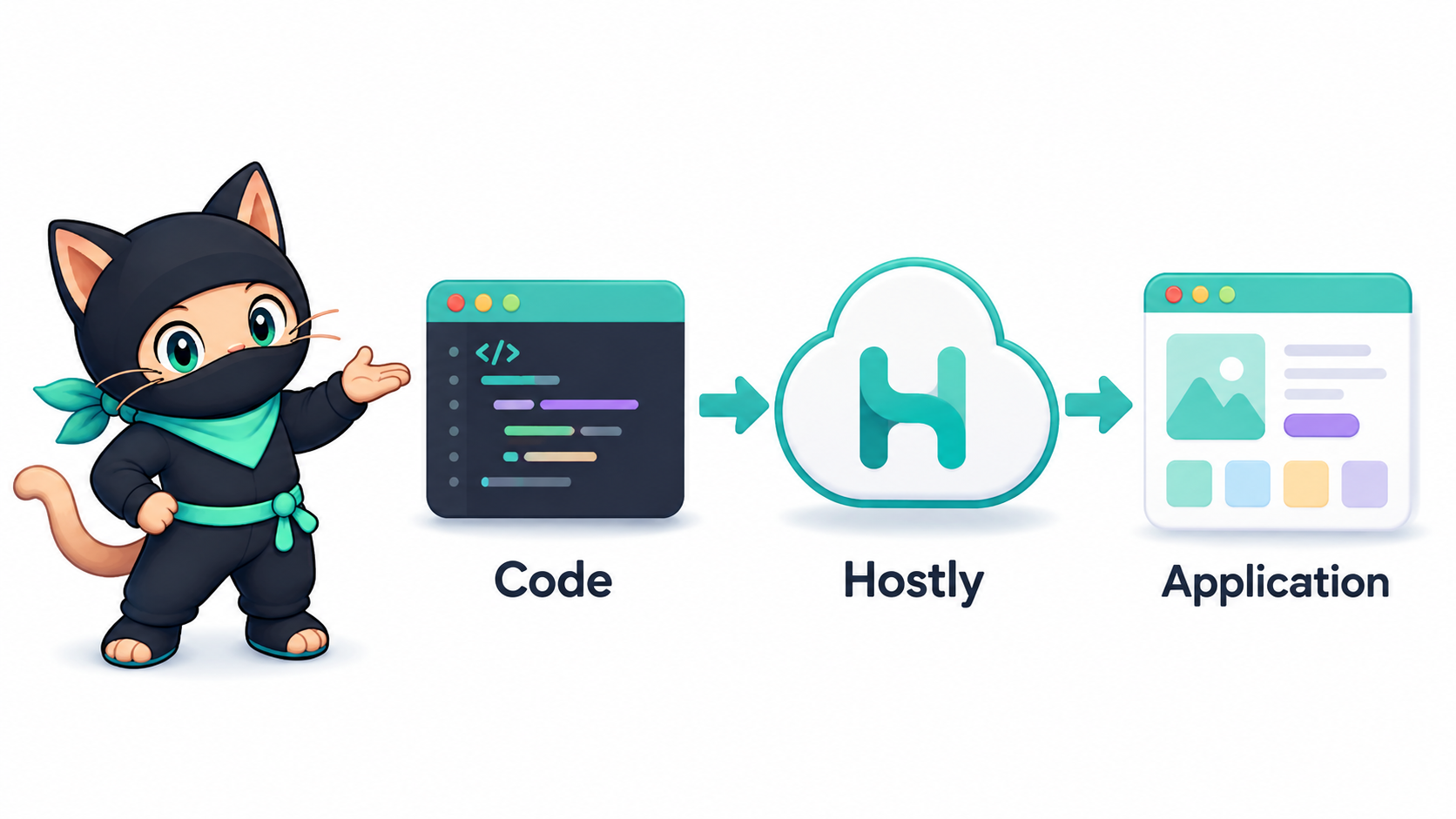
Hostly is a hosting platform for developers who want to get applications online without first turning deployment into its own project. This means you bring the application and Hostly takes care of most of the things between your code and a working deployment.
No Kubernetes knowledge required, pinky promise!
We promise not to quiz you on Ingress, PersistentVolumeClaims or why DNS sometimes takes exactly long enough to make you question your life choices.
So, what is Hostly?
At its core, Hostly lets you deploy and run containerized applications with as little infrastructure work as possible.
You provide a Docker image, configure the resources your application needs (environment variables, Volumes), and deploy it.
Pricing follows much the same idea. Hostly is pay-as-you-go: CPU, memory, storage and network traffic are metered based on what your applications actually use. There are no fixed instance sizes you need to squeeze your application into, and if it needs more resources later, you can simply give it more.
Our plans do have a small monthly minimum, but your actual usage counts towards it. So rather than paying for a predefined bundle of resources whether you use them or not, you mostly pay for what you consume.
Behind the scenes there is, unsurprisingly, quite a lot going on: containers need to be scheduled, traffic routed, certificates issued, storage attached and workloads kept running.
We think most of that should remain our problem.
“We wanted deploying an application to feel like the last step of building it, rather than the first step of learning an entirely new infrastructure stack.”
- Michael Zigldrum, Hostly Co-Founder
Hostly is not meant to pretend infrastructure does not exist. It is meant to give you a useful abstraction over the parts you probably did not set out to manage yourself.
Why did we build it?
We have spent a fair amount of time working with Kubernetes, cloud infrastructure, CI/CD pipelines, networking and the assorted collection of YAML files that comes with them.
Unbelievably, we actually enjoy that work.
That is also one of the reasons we know that not everybody should have to do it.
Getting an application from “works on my machine” to “works on the internet” still tends to introduce a surprising number of new concepts. Containers, registries, DNS, TLS, networking, deployment pipelines, storage and resource management can all become part of the job before the first real user has even arrived.
For someone who simply wanted to ship an application, it is a fairly large detour to an accessible app.
And that gap has become more noticeable as building software itself has become easier. Modern frameworks, developer tooling and AI-assisted development can get you surprisingly far surprisingly quickly. Deployment, on the other hand, can still feel like somebody suddenly changed the subject.
“The tools for building software have become much more accessible. We think running that software should follow the same direction.”
- Andreas Knipl, Hostly Co-Founder
What we want Hostly to be
We are not trying to remove every technical decision from hosting, we are trying to remove the ones that should not matter yet.
You should be able to deploy something small or big without designing a cloud architecture first, connect a domain when you need one, add resources as your application grows and still have a sensible path forward when things become more serious.
There is plenty we still want to build, and some things will inevitably become more complicated as Hostly grows.
But the basic idea is unlikely to change:
You build the application. We deal with the infrastructure.
A civilized arrangement, if you ask us.


